
1. Introduction
Satya Nadella recently wrote how AI creates a real cognitive loop between people and digital systems. In the past, digital systems were used to enhance human capital; but AI models can now absorb the expertise of humans and organizations. Every company will have human capital and token capital. The token capital will be the AI capabilities of the firm. AI agents are increasingly transitioning into becoming "digital workers". It's not far from now when companies will have more digital workers than human employees.
What changes as the digital workforce of companies become larger than the number of human employees? First, pricing moves to selling services and outcomes rather than software tools. As human seats are no longer a good proxy for value delivered, companies are increasingly pricing value in terms of outcomes delivered. Unlike in the past where companies managed physical or software infrastructure, companies will manage digital workers that deliver services.
This completely changes how you think of the organizational structure of a company when most of its workforce is agentic. Instead of the agents being a part of infrastructure or tooling, they are the company.
We've seen this pattern before. Networking became software-defined networking. Infrastructure became software-defined infrastructure. As labor itself becomes programmable, companies become software-defined companies.
The primary challenge will become designing and operating digital workforces to deliver customer outcomes. The rest of this essay explores what the organizational primitives would look like for software defined companies.
2. Software-Defined Companies
The first generation of AI startups sold AI agents, think AI medical scribes, SDRs, recruiters. Then they sold outcomes - meetings delivered, customer tickets closed, employees hired. The gap between product companies and AI-native agencies will continue to close. You can think of a company like Harvey not as a provider of AI agent infrastructure but rather as a law firm with thousands of digital associates working across thousands of clients.
Each of these companies can be thought of as a system of agents that continually self-improve. For example, you could construct an SEO agency by wiring up per-customer, long horizon consultant agents with internal, differentiated services like a SEO content writer. These consultants are closer to autonomous agents with memory, skills, and heartbeats like OpenClaw while the SEO content writer agents are closer to simple LangGraph agents. These consultants continually work on their clients' websites and an internal supervisor agent evaluates their performance and continually scaffolds skills and playbooks that are shared across the agency.
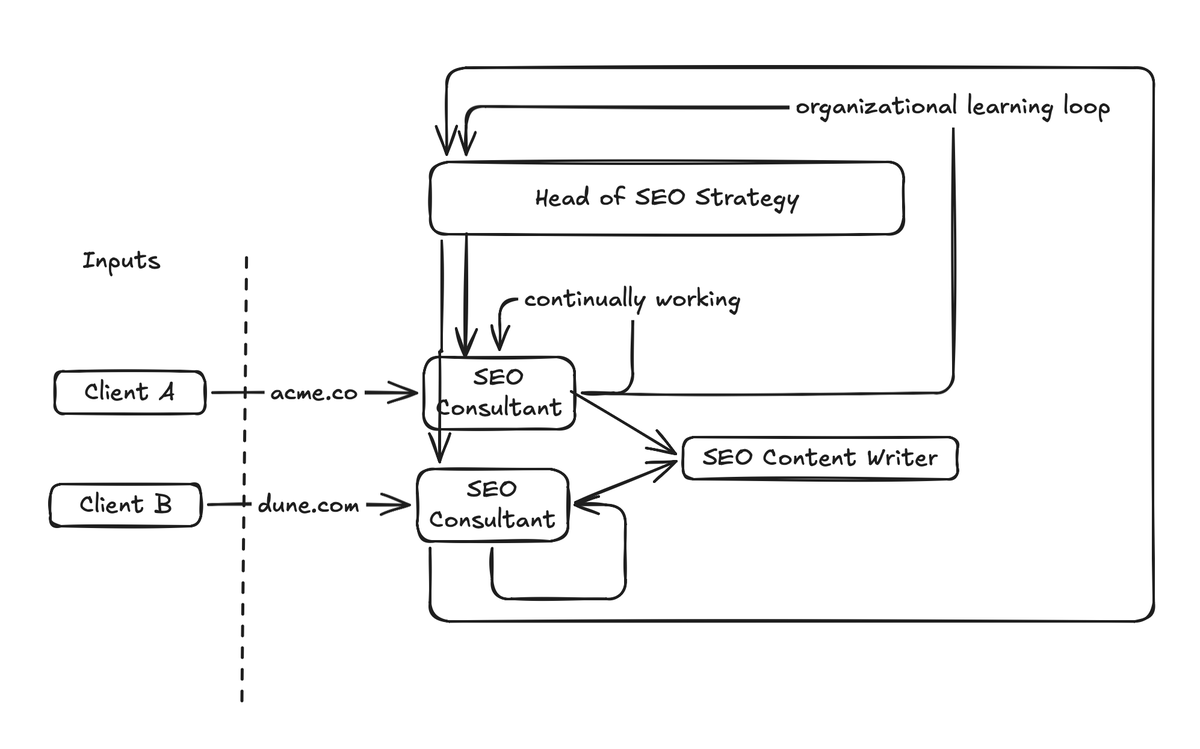
There is an explosion of companies like Polsia, Cofounder, Vibiz, etc. that are trying to implement proprietary versions of this for their own autonomous companies.
2.1. Primitive: Progressive Rollouts
One of the benefits of an agent-drive company is that you can easily rollback changes if they don't increase output. You can also isolate changes and experiment cleanly with changes in your organizational architecture.
The best operators in this space will quantify how changes in their agent systems affect user satisfaction and output. Offline evals won't be enough; there will be a change management lifecycle in production. They will start with a canary deployment and gradually roll out agent system changes across customers. Online evals will inform the deployment to continue or rollback.
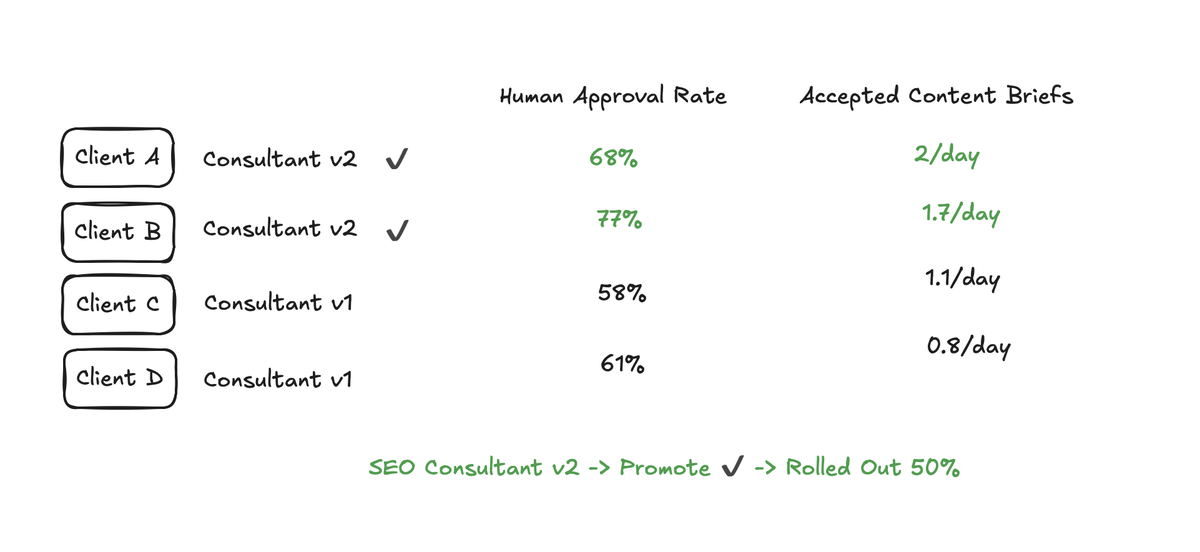
2.2. Primitive: Org-wide Agent Harnesses
Most of the agents today are fundamentally single player, they only talk to you and have context based on conversations only with you. This is fine for the copilot paradigm where agents are assisting humans in their work. In the future, most agents will be autonomous and multiplayer.
A multiplayer harness needs to manage and share context a huge pool of contextual memory between all agents in the organization. It also needs to guarantee certain levels of privacy, e.g. if you are DMing an agent over Slack you don't want it to spread rumours.
2.3. Primitive: Information Hierarchy
Every company has a pool of institutional memory that has a partial ordering from top to bottom. For example, every SEO agency has a set of playbooks and SOPs they use. For specific verticals, they will have domain specific knowledge that customizes these playbooks. And finally, they will have proprietary, client-specific knowledge that should not be shared.
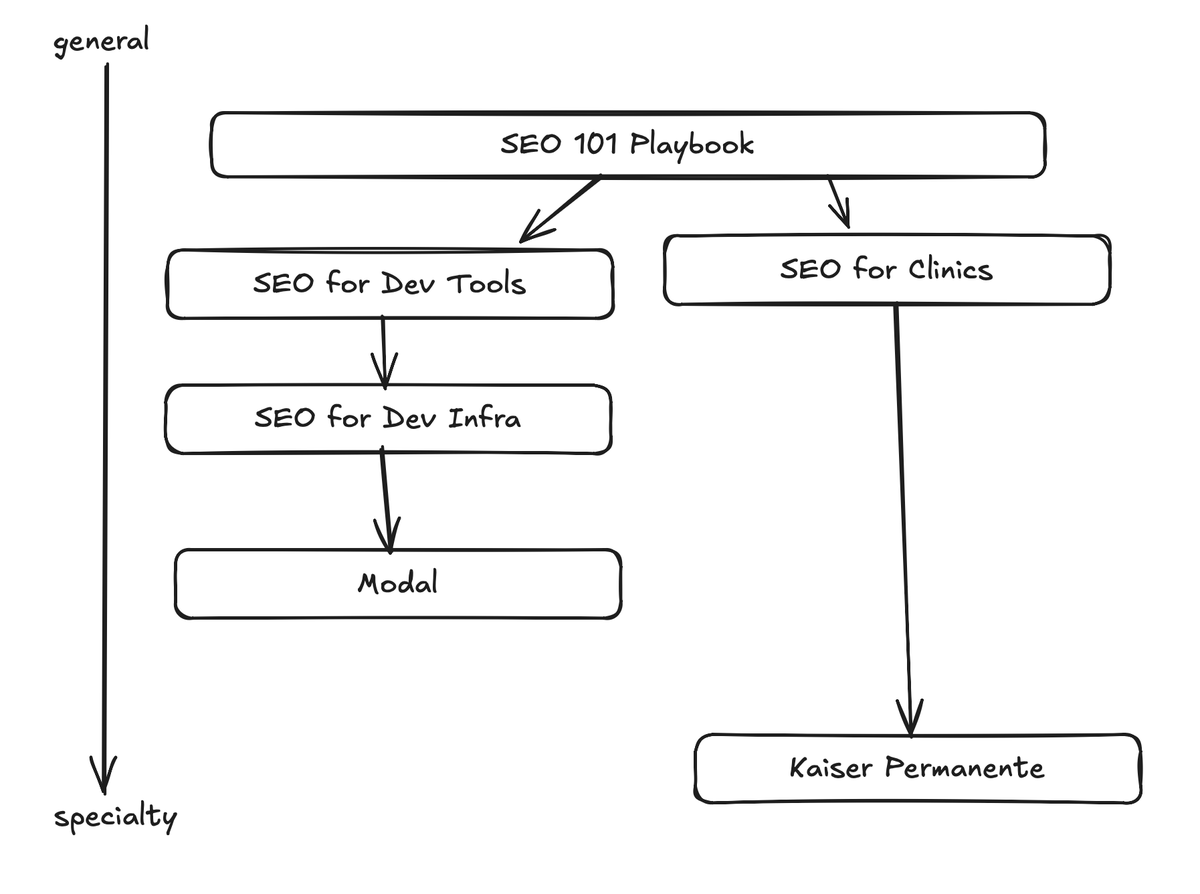
Agent systems will live at each step of the information hierarchy, forming self-improving loops at every level of the organization.
3. Infrastructure
Lately I've been thinking about how the ideal platform for constructing these primitives into software-defined companies would be. The infrastructure required to manage these workforces doesn't exist today. Looking across these primitives, the conclusion I've arrived at is that software-defined companies need declarative infrastructure.
I suspect there exists a universal abstraction where you can define these agent systems as configuration instead of a sprawl of imperative code. Something similar to how you provision infrastructure with Terraform and workloads with Kubernetes. New agent frameworks like Vercel's Eve and Astro's Flue are also moving in this direction with configuration-first architecture.
That's the direction I've been exploring with Talon. Agents, skills, workflows, namespaces, deployment policies, and evaluation strategies become durable resources that can be configured and operated much like Kubernetes for cloud infra. Namespaces mirror the information hierarchy of a company, allowing workers to inherit tools, skills, and knowledge into increasingly specific organizational scopes without leaking customer-specific information.